Rudolf E. Kálmán
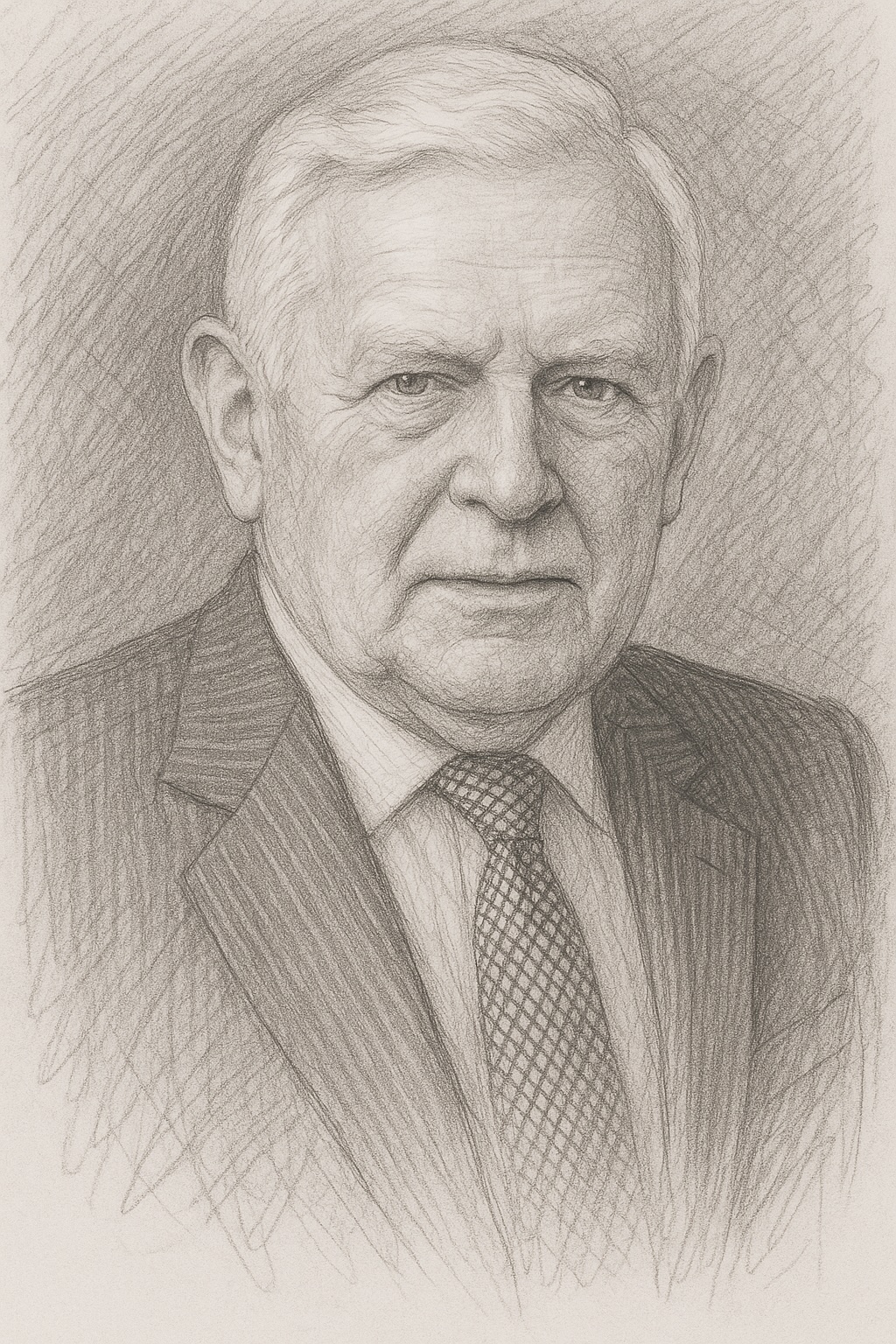
Rudolf Emil Kálmán (May 19, 1930 – July 2, 2016) was a Hungarian-born American electrical engineer and mathematician. His 1960 paper "A New Approach to Linear Filtering and Prediction Problems" introduced the recursive estimator that carries his name, the Kalman filter, and his work on state-space methods laid much of the foundation of modern control and systems theory.
Early life and education
Kálmán was born in Budapest, Hungary, in 1930. His family left Hungary during the Second World War and emigrated to the United States in 1943. He studied electrical engineering at the Massachusetts Institute of Technology and received his doctorate from Columbia University in New York in 1957.
Career
After his doctorate, Kálmán worked at the Research Institute for Advanced Studies (RIAS) in Baltimore, where he developed the filter. He later held professorships at Stanford University, at the University of Florida in Gainesville, where he was part of the engineering faculty for more than twenty years, and at ETH Zurich. He died in Gainesville, Florida, on July 2, 2016, at the age of 86.
The Kalman filter
In 1960 Kálmán published A New Approach to Linear Filtering and Prediction Problems in the Journal of Basic Engineering. Instead of the frequency-domain formulation of the Wiener filter, he described the signal with a state-space model and derived a recursive estimator based on the orthogonality principle, i.e. the linear MMSE estimator of the state. The recursion needs only the last estimate and its covariance, which made it ideal for the digital computers of the time.
The continuous-time counterpart followed in 1961 together with Richard S. Bucy as the Kalman–Bucy filter. Related ideas had appeared earlier, for example in work by Peter Swerling and Ruslan Stratonovich, but the clarity and generality of Kálmán’s formulation drove its adoption.
Apollo and beyond
One of the first and most famous applications was navigation for the Apollo program. Stanley F. Schmidt at NASA Ames recognized the potential of Kálmán’s work and extended it to nonlinear trajectory estimation, which became the Extended Kalman Filter. Since then the Kalman filter has become a standard tool in navigation, tracking, robotics, automotive systems, economics and signal processing.
Contributions to systems theory
Beyond filtering, Kálmán introduced or formalized central concepts of state-space control theory:
- Controllability and observability of linear systems, and the rank tests that carry his name,
- the Kalman decomposition of a system into controllable/observable subsystems,
- the duality between optimal estimation and optimal control (the linear-quadratic regulator),
- contributions to realization theory, i.e. constructing state-space models from input-output data.
Awards
Kálmán received many of the highest honors in engineering and science, among them the IEEE Medal of Honor (1974), the IEEE Centennial Medal (1984), the Kyoto Prize in Advanced Technology (1985), the Steele Prize of the American Mathematical Society (1987), the Richard E. Bellman Control Heritage Award (1997), and the Charles Stark Draper Prize of the National Academy of Engineering (2008). In 2009, President Barack Obama presented him with the National Medal of Science.
Further reading
- The original papers with DOIs and short summaries: Kalman filter classic papers
- Other pioneers: Richard S. Bucy, Yaakov Bar-Shalom
- The filter itself: Kalman filter equations
References
[1] A. C. Antoulas, T. T. Georgiou, P. P. Khargonekar et al. (2016). “Obituary for Professor Rudolf Emil Kalman”. Automatica, 74, 370–371.
[2] University of Florida, Herbert Wertheim College of Engineering (2016). “Remembering Rudolf E. Kalman (1930–2016)”.
[3] R. E. Kalman (1960). “A New Approach to Linear Filtering and Prediction Problems”. Journal of Basic Engineering, 82(1), 35–45. doi:10.1115/1.3662552